Art as a Reflection on the Past
While Pop Art embraced the imagery of mass culture, other artists sought the silence and openness of the landscape. Away from the city, commercial interests and traditional exhibition spaces. Rather than depicting the landscape, they began to use the landscape itself as the starting point for their work.
During the 1960s and 1970s, there was a growing interest in more philosophical and contemplative forms of art. Land Art was one of the movements in which this development became visible.
Nature had long been a refuge for those wishing to distance themselves from industrialisation and mass culture. The social unrest around 1970 also played a role. Some artists challenged the commercial art market and established art institutions. In the United States, the Vietnam War, capitalism and increasing commercialisation formed an important part of the wider social climate.
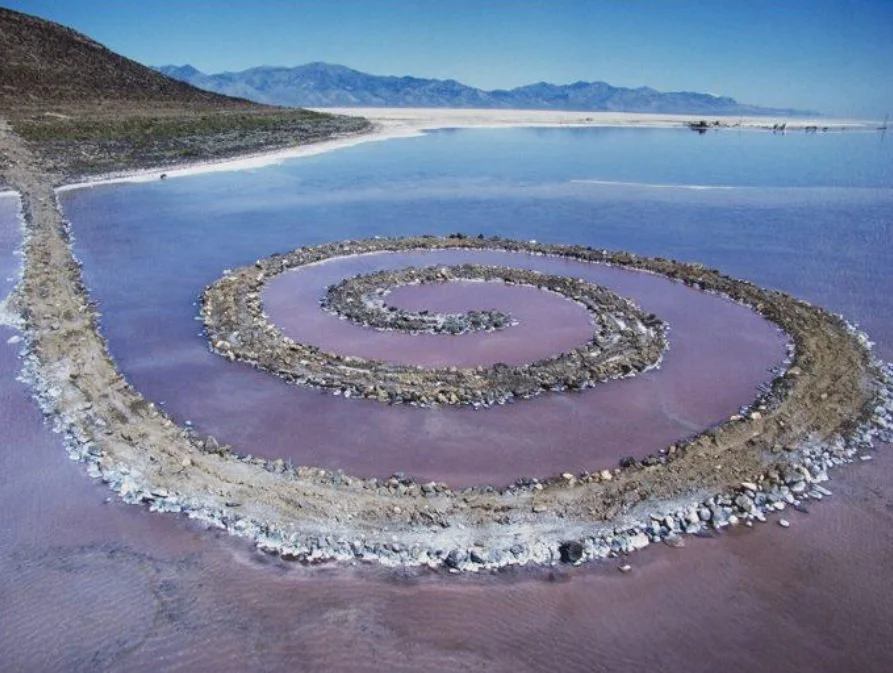
Spiral Jetty
Nature had long served as a refuge for those seeking to distance themselves from industrialisation and mass culture. The social unrest around 1970 was also reflected in the arts. Some Land Art artists challenged the commercial art market and traditional art institutions. In the United States, the Vietnam War, capitalism and increasing commercialisation formed part of the wider social climate.
The desire to leave behind the noise, technology, pursuit of profit and pollution of urban life led artists to explore a different relationship with nature.
The landscape became more than a place to exhibit art. It became part of the artwork itself. This also introduced a different way of seeing. Why should an artist add something to a space that already has meaning in its own right?
In certain forms of Land Art, a romantic, almost mystical longing can be recognised. Working in nature sometimes took on a meditative quality. What mattered was not only the finished artwork, but also the experience of being present, observing and engaging with a place.
Just as a composer works with notes and sounds, lines, traces and signs play an important role in the work of artists such as Dennis Oppenheim, Walter De Maria and Richard Long. Their work reveals the relationship between time, space and landscape.
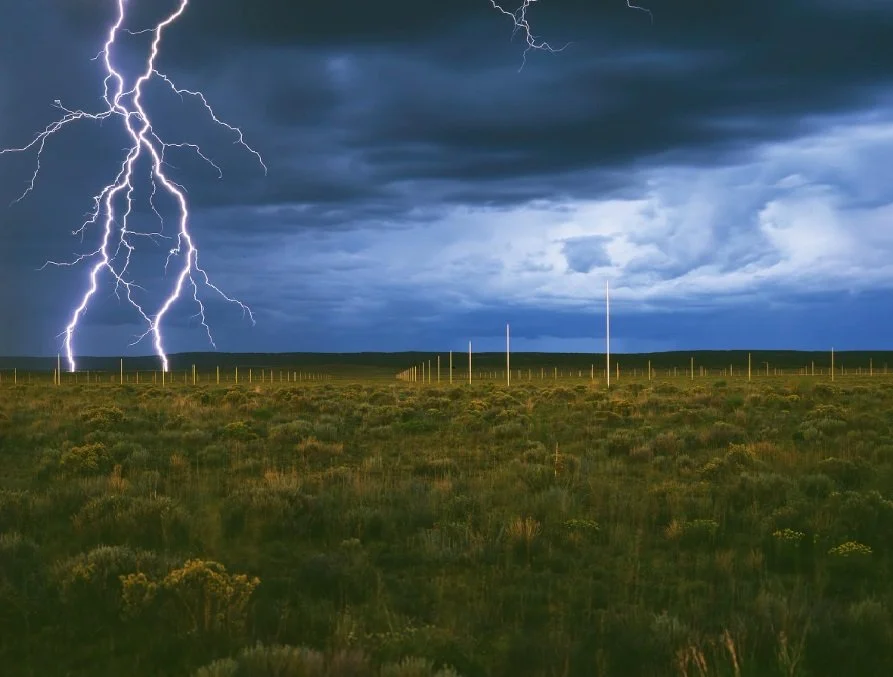
Walter de Maria
Yet their approaches differ considerably. Oppenheim and De Maria also created large-scale physical interventions in the landscape, while Richard Long generally adopted a much more restrained approach.
It is precisely these modest, sometimes barely visible interventions that interest me. A line in the grass, a trail of footsteps or a temporary arrangement of stones. Actions that alter very little in the landscape, yet can change the way we perceive it.
It is striking how both British and American Land Art around 1970 reveal aspects of a neo-romantic relationship with the landscape. At the same time, different approaches emerged. While some American artists created monumental interventions, Richard Long approached the landscape primarily as a space to experience and move through.
For Long, walking is not merely a way of travelling from one place to another, but an artistic act in itself. Through his body, his movement and the passing of time, a temporary relationship with a place takes shape. Photographs, maps, drawings and texts then become traces of that experience.
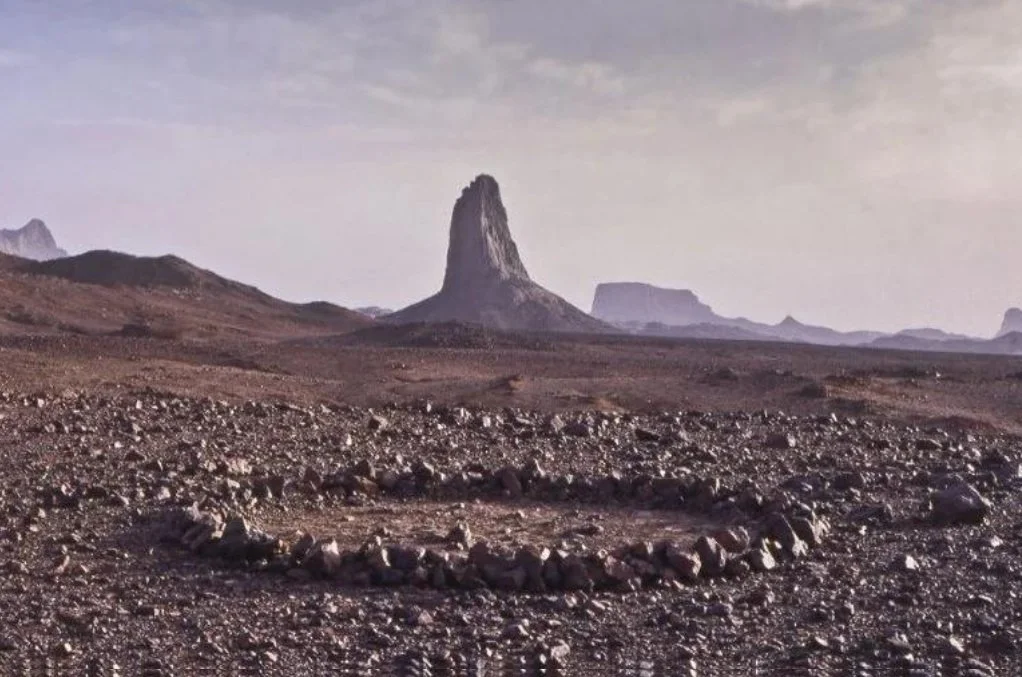
Richard Long Midday Muezzin Line (2006)
He enters a landscape, briefly becomes part of it and leaves it largely unchanged. Rather than shaping nature to his will, he allows the landscape to become the setting in which his work unfolds.
When does a walk become a work of art? Is it the act itself, the trace left behind, or the idea that came before it?
Perhaps this is where the particular significance of this form of Land Art lies. A landscape does not need to be radically transformed for us to experience it differently. Sometimes a simple action is enough to reveal something that has been there all along.
The myth of the landscape, as a place of silence, openness and discovery, is thus preserved, at least to some extent.
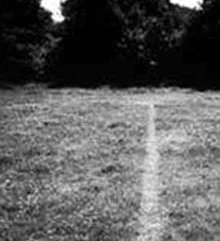
A Line Made by Walking,