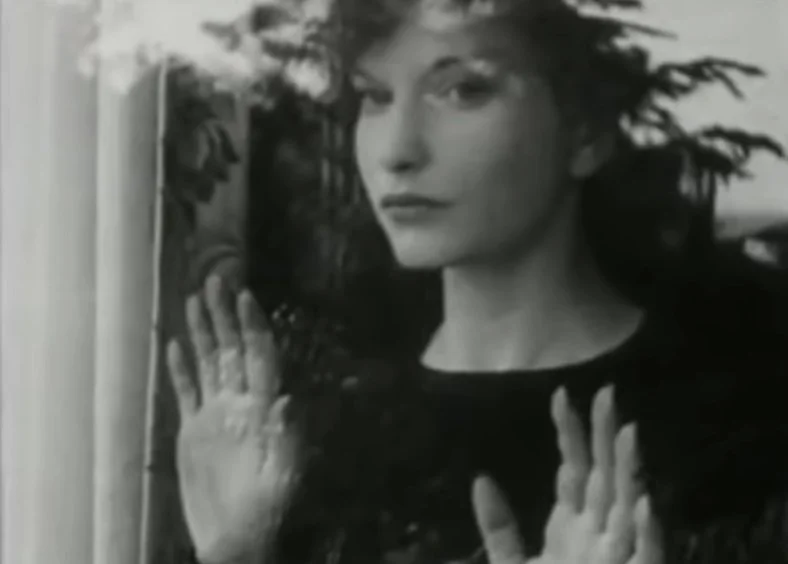
Avant-garde film Meshes of the Afternoon - Maya Deren 1943
What happens when a film feels more like a dream than a story?
A woman walks up a garden path. She notices a flower lying on the ground and picks it up. Entering her house, she falls asleep in a chair. What follows is a strange sequence of recurring events, shifting realities and dreamlike encounters that continue to fascinate viewers more than eighty years after the film was made.
Director Maya Deren, born in Kiev and active in New York during the 1940s and 1950s, is considered one of the pioneers of American experimental cinema. With Meshes of the Afternoon, she helped establish an entirely new way of thinking about film. Rather than telling a conventional story, Deren used cinema to explore dreams, memory, identity and the subconscious.
Influenced by Surrealist films such as Un Chien Andalou by Luis Buñuel and Salvador Dalí, Deren developed a highly personal visual language in which poetic imagery and symbolism became more important than narrative logic.
The result is what is often regarded as one of the most influential American avant-garde films ever made.
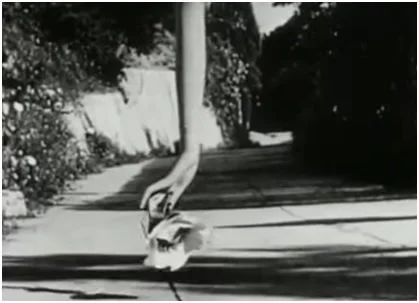
The Flower Film Still
The Flower
The first marker on the journey.
The flower appears at the very beginning of the film. At first glance it seems insignificant, yet it acts almost like an invitation. It is the first object that draws the protagonist away from ordinary reality and into a different psychological space.
Like many symbols in the film, its meaning remains open. Is it desire? Memory? A guide? Or simply the first step into a dream?
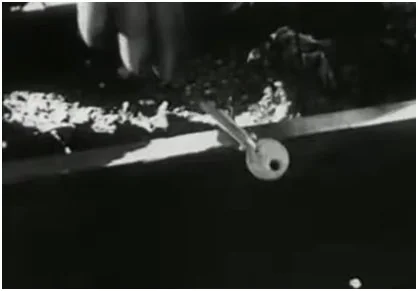
The Key Film Still
The Key
A symbol of passage and transformation.
Throughout the film, objects repeatedly change meaning. The key is perhaps the most important example.
Keys traditionally suggest access, entry or revelation, but Deren uses it in a far more ambiguous way. The key reappears throughout the film, guiding the viewer deeper into a fragmented reality where time loops back on itself and familiar spaces become unfamiliar.
What exactly does the key unlock?
The answer is never fully given.
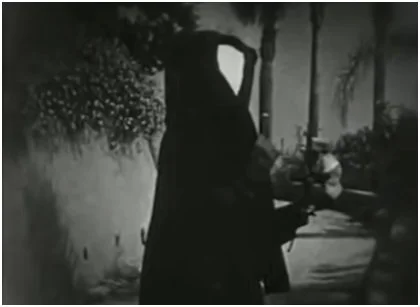
The Mirror-Faced Figure Film Still
The Mirror-Faced Figure
An elusive destination.
One of the most iconic images in avant-garde cinema is the mysterious hooded figure whose face is replaced by a mirror.
The protagonist repeatedly follows this apparition through pathways, corridors and dream spaces, yet never truly reaches it. The figure functions almost like a destination that constantly withdraws from view.
It remains one of the film's most haunting and memorable images.
What do you think the mirror-faced figure represents?
Identity? Death? The subconscious? Or perhaps a reflection of the viewer themselves?
A Personal Reflection
What fascinates me most about Meshes of the Afternoon is the way Maya Deren transforms a simple domestic environment into a psychological landscape.
The recurring pathways, repeated actions and circular structure remind me strongly of themes that return in my own work. Many of my sculptures, textile works and wall pieces explore ideas of mapping, orientation, labyrinths and inner journeys. These are not maps of geographical places, but visual explorations of memory, identity and human experience.
Seen from this perspective, the flower, the key and the mirror-faced figure become more than symbols. They function almost like landmarks on an inner map, guiding us through a territory that cannot be measured or fully understood.
Like a labyrinth, the film offers no clear destination. Every return reveals a subtle transformation. Every repetition opens another layer of meaning.
Perhaps this is why Meshes of the Afternoon remains so compelling. The journey is not through a landscape, but through consciousness itself.
While watching the film, pay attention to these three recurring elements:
• The flower
• The key
• The mirror-faced figureHow do their meanings change throughout the film?
And what happens when a film stops telling a story and starts behaving like a dream?